
LOOK GREAT AT ANY AGE
Breast Augmentation in Nashville, TN
Nashville board-certified plastic surgeon Dr. Don Griffin has been performing breast augmentation for more than 20 years — and the procedure has never been better. Today’s implants last longer, offer more choices in size and projection, and are placed using techniques that significantly reduce recovery time and the risk of complications. Dr. Griffin’s breast augmentation patients in Nashville, Tennessee experience minimal discomfort after surgery, rarely need narcotic pain medication, and quickly return to their active lifestyles with beautiful, natural-looking results that suit them perfectly.
HOW CAN BREAST AUGMENTATION HELP?
For Nashville women, breast augmentation with implants is the simplest, most effective option for increasing breast volume by more than half a cup size (which is the average size increase with fat transfer). Today’s 5th-generation silicone and saline implants can last for decades, providing patients with years of self-confidence and improved appearance. Breast augmentation is ideal for correcting a variety of concerns, which include:
- Breasts that are too small for the patient’s frame
- Asymmetrical breasts with uneven volume
- Variations in the shape of the chest wall that cause the breasts to look different from each other
- Breasts that have lost volume and firmness after pregnancy, breastfeeding, or weight loss. Women looking to address multiple post-pregnancy changes at once may also be candidates for a mommy makeover.
DR. GRIFFIN’S INDIVIDUALIZED APPROACH TO BREAST AUGMENTATION
While breast augmentation in Nashville is a commonly performed procedure, beautiful results depend on optimal technique and surgical decision-making. Dr. Griffin likes to say that breast augmentation is a simple procedure for an experienced surgeon; however, if breast augmentation is done wrong, it can be a costly mistake that may never be totally correctable. Time and again, Dr. Griffin sees patients unhappy with their breast augmentation results who require revision surgery because their previous surgeon chose the wrong implant or used the wrong technique on a patient with sagging breasts.
Every woman’s body and breasts are different; these differences all effect the final breast augmentation results. Every step in the procedure has an impact on the final outcome. There actually are a myriad of variables that all have to be taken into account to achieve the optimal result for each patient. The following decisions must be made carefully:
Incision Placement
The most commonly used placement options for breast augmentation incisions are:
- Around the lower edge of the areolas (periareolar)
- In the armpits (transaxillary)
- In the fold beneath the breasts (inframammary)
Dr. Griffin prefers the inframammary incision for breast augmentation for a number of reasons. It allows for the smallest incision length possible with the most precise dissection of the breast implant pocket—one of the most important factors in achieving a breast shape that looks natural and not “augmented.” Additionally, the inframammary incision has the lowest incidence of capsular contracture, less sensory loss than other approaches, and makes it easier to perform implant replacement surgery (if necessary or desired in the future).
Implant Placement
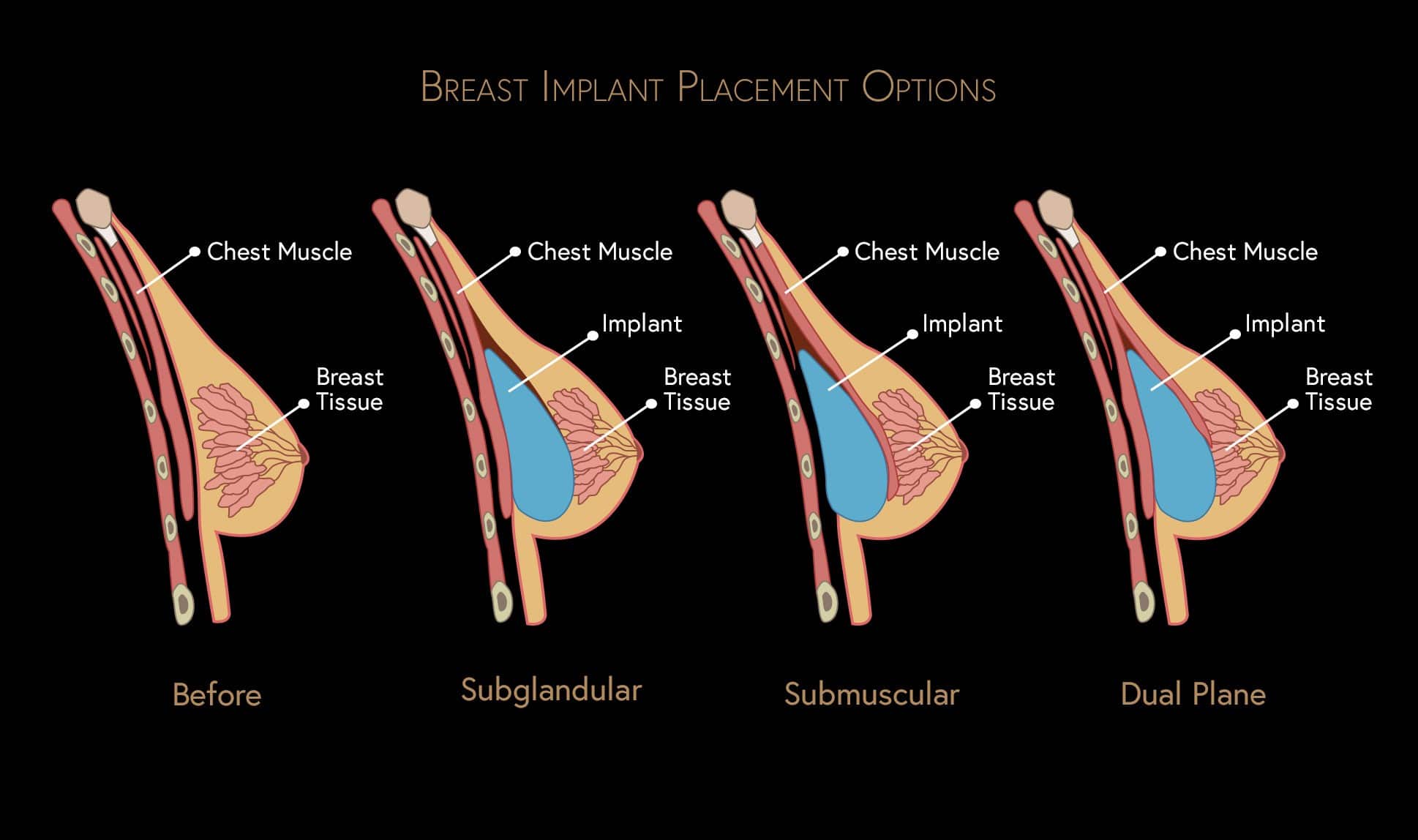
During breast augmentation surgery, Dr. Griffin creates a space, called a pocket, within the breast for the implant. Placement options for the implant include (see illustration):
- Directly behind the breast tissue (subglandular)
- Behind the breast tissue and the chest muscle (submuscular)
- Partially behind the chest muscle and partially behind the breast tissue (submuscular dual plane)
IS IT BETTER TO HAVE BREAST IMPLANTS PLACED UNDER THE MUSCLE?
For primary breast augmentation, Dr. Griffin prefers to use the submuscular (under the muscle) dual plane approach. For revision procedures, he decides on implant placement on a number of factors; he uses all 3 approaches in different situations.
HOW DO I CHOOSE THE RIGHT SIZE BREAST IMPLANT?
During your consultation, Dr. Griffin spends a considerable amount of time sizing implants to ensure they are appropriate for your anatomic dimensions and to create natural-looking breasts that are the size and shape you desire. Breast implants don’t come in cup sizes; they are measured by the volume of silicone or saline they hold, as well as their diameter and projection. Key measurements that have a major impact on your results include:
- The diameter of your natural breasts and the width of your chest wall
- The amount of breast tissue you currently have and your desired size
- Your overall body size and where your breast folds sit on your torso
- How symmetric or asymmetric your natural breasts look
While the majority of implants that Dr. Griffin places range between 240 and 450 cc, there are some petite patients that need smaller implants and some fuller figured women that can accommodate larger implant sizes. In all cases, patients can be assured that Dr. Griffin will never place implants that will be out of proportion to the size of their frames. Dr. Griffin uses sterile intraoperative sizers to ensure that the implant size and profile chosen in consultation look appropriate for the patient’s desired result when placed into the breast pocket.
Nashville Cosmetic Surgery serves patients from Nashville, Brentwood, Franklin, Belle Meade, Green Hills, and the greater Middle Tennessee area.
SALINE VS. SILICONE BREAST IMPLANTS: WHICH IS RIGHT FOR YOU?
Silicone gel implants, approved for patients age 22 and older, provide the most natural look and feel. New, 5th generation, smooth, round, cohesive silicone gel implants are far superior to the silicone implants used years ago. There are now options for choosing different thicknesses of silicone gel to achieve the most natural feel while minimizing the possibility of implant wrinkling. There are even highly cohesive “gummy bear” implants for women with thin skin and minimal breast tissue.
Saline implants are filled with a sterile saltwater solution and approved for patients 18 and older. This option is less expensive than silicone and leaks are easier to detect because the implant deflates rapidly. Saline implants tend to feel stiffer than silicone and have a higher incidence of wrinkling and rippling, especially in thin women with little to no breast tissue.
Both silicone and saline implants have fairly equal safety profiles and longevity. All implants do eventually need to be replaced. Patients who need to replace or revise existing implants can learn more about Dr. Griffin’s breast revision procedures. Dr. Griffin typically recommends replacing implants every 15 to 20 years. He advises all patients with breast implants to have yearly follow-up exams to check their implants and breast tissue.
HOW DO I CHOOSE IMPLANT PROFILE, SHAPE, AND TEXTURE?
While breast implant sizes are measured in volume, implants that are the same size are available in a variety of profiles. Breast implant profile, such as high or low, is a ratio of the implant’s diameter to its projection (how far it sticks out) from the chest wall. High profile implants tend to produce a breast with a fuller upper pole than possible with medium or low profile implants. Different profiles allow for an exact tailoring of the implant size to the patient’s individual frame dimensions. Dr. Griffin prefers to use smooth surfaced round implants due to their better safety record.
During your consultation, you will be allowed to handle both silicone and saline implants to help you decide which type you want. Dr. Griffin also has patients “try on” a variety of implant profiles and sizes to see what will best fit their frames and achieve your aesthetic goals.

HOW DO YOU PERFORM BREAST AUGMENTATION SURGERY?
Breast augmentation is an outpatient procedure performed under general anesthesia or deep sedation. Dr. Griffin begins by making an incision along each breast crease through which he creates a pocket for the implant. Using intraoperative sizers, he evaluates the breasts for shape, size, and symmetry, making adjustments as necessary.
Once he has achieved the desired results, he inserts the actual breast implants into each pocket. Saline implants are filled after they are placed. Silicone gel implants are inserted using a device called a Keller Funnel®. This cone-shaped sleeve, which looks much like a pastry bag, offers the following benefits:
- Inserting implants through smaller incisions
- Minimizing impact to the patient’s tissues
- Decreasing surgical time
- Reducing the risk of contamination (which reduces the risk of infection and capsular contracture)
WHAT SHOULD I EXPECT AFTER BREAST AUGMENTATION?
After a brief observation period in the surgery center, patients are free to go home in the care of a trusted adult. Dr. Griffin uses a combination of preoperative and postoperative non-narcotic medications to minimize pain and shorten recovery time. With this novel approach, most patients do not need narcotics for pain.
Postoperative care consists of using silicone scar gel and broadband light therapy if needed to maximize wound healing and to minimize scarring.
HOW LONG IS BREAST AUGMENTATION RECOVERY?
It’s typical for Dr. Griffin’s breast augmentation patients to resume normal low impact activities and return to non-strenuous work in a matter of days. Some exercising can be resumed in 1 to 2 weeks; however, you should avoid running and other impact activities for several weeks.
Dr. Griffin’s precise pocket plication and use of advanced surgical techniques results in minimal swelling. The breasts tend to settle into their final position quickly, sometimes within a month or two.

COMMON QUESTIONS ABOUT BREAST AUGMENTATION
What types of breast implants does Dr. Griffin offer?
Dr. Griffin offers both saline and silicone implants, including cohesive gel ("gummy bear") silicone implants. During your consultation, he will walk you through the differences in feel, projection, and longevity, and help you select the implant type, size, and profile best suited to your frame and aesthetic goals.
What is the difference between silicone and saline implants?
Silicone implants are filled with a cohesive gel that closely mimics the feel of natural breast tissue and are FDA-approved for women 22 and older. Saline implants are filled with sterile saltwater, tend to feel firmer, and are FDA-approved for women 18 and older — with the advantage of immediate detection if a rupture occurs. Dr. Griffin will walk you through the pros and cons of each option based on your anatomy and goals during your consultation.
How do I know what implant size is right for me?
Implant sizing is one of the most important — and most personal — decisions in breast augmentation. Dr. Griffin takes a highly individualized approach using tissue measurements, 3D imaging, and direct patient input. His goal is to recommend a size that achieves your desired look while remaining proportional to your frame. There is no single right size — the right size is the one that is right for your body.
Where will my incisions be placed?
Dr. Griffin prefers the inframammary incision — in the natural crease beneath the breast — for a number of reasons. It allows for the smallest incision length possible with the most precise dissection of the breast implant pocket, which is one of the most important factors in achieving a result that looks natural and not "augmented." It also carries the lowest incidence of capsular contracture, results in less sensory loss than other approaches, and makes future implant replacement easier to perform. In cases where a periareolar or transaxillary incision better serves your specific anatomy or goals, Dr. Griffin will explain his reasoning and discuss that with you during your consultation.
Should I choose implants over or under the muscle?
Dr. Griffin most commonly places implants in a submuscular or dual-plane position, because this approach typically produces a more natural look and feel, reduces visible implant edges, lowers the risk of capsular contracture, and preserves mammography accuracy. Subglandular placement is the right choice in certain anatomical situations — particularly for very active patients or those with specific tissue characteristics where submuscular placement is less ideal. Dr. Griffin evaluates each patient individually and will explain his recommendation for your anatomy.
Will breast augmentation leave visible scars?
Scarring is a natural part of any surgery. Dr. Griffin makes incisions in discreet locations — most commonly in the natural fold beneath the breast — so scars are minimal and well-concealed by bras and swimwear. He uses advanced suturing techniques to optimize scar appearance, and scars typically fade significantly over the 12 months following surgery.
What is recovery like after breast augmentation?
Most patients return to desk work and light daily activities within one week. Strenuous exercise and heavy lifting are typically restricted for 4–6 weeks. You will experience some soreness, swelling, and tightness in the first week, which gradually improves. Dr. Griffin provides detailed written aftercare instructions and our team is available to answer questions throughout your recovery.
How long do breast implants last?
Modern breast implants are not lifetime devices, but they are very durable. Most implants last 15–20 years before replacement is needed, though many patients go longer without issues. Dr. Griffin recommends a breast implant ultrasound beginning at 3 years post-augmentation to monitor implant integrity. Nashville Cosmetic Surgery provides this complimentary to all breast implant patients at their annual visit. Dr. Griffin will discuss what to watch for at each follow-up.
Will breast augmentation affect breastfeeding or mammograms?
Most patients can still breastfeed after augmentation, particularly with inframammary or transaxillary incisions that avoid the areola and milk ducts. For mammograms, you will need to inform the technician that you have implants so additional views can be taken. Submuscular placement generally allows for better mammogram accuracy than subglandular placement.
Can breast augmentation be combined with a breast lift?
Yes. Many patients benefit from augmentation combined with a mastopexy (breast lift), particularly if there is significant sagging or volume loss following pregnancy or weight loss. Dr. Griffin frequently performs this combination procedure and will assess whether it is right for you based on the degree of ptosis (drooping) and your desired outcome.
Does breast augmentation correct sagging breasts?
Breast augmentation adds volume and fullness but does not lift the breast or correct sagging (ptosis). If your nipple falls at or below the inframammary fold, augmentation alone is unlikely to achieve your desired result. In these cases, Dr. Griffin may recommend combining breast augmentation with a breast lift for a more complete outcome. He will assess your degree of ptosis during your consultation.
What risks should I be aware of?
As with any surgery, breast augmentation carries risks including infection, bleeding, changes in nipple or breast sensation, capsular contracture (scar tissue hardening around the implant), implant rupture or leakage, and the need for revision surgery. Dr. Griffin will review all risks with you thoroughly during your consultation and will take every precaution to minimize them.
How much does breast augmentation cost at Nashville Cosmetic Surgery?
The cost varies depending on implant type, surgical complexity, and anesthesia and facility fees. During your consultation, you will receive a detailed, itemized quote with no hidden costs. Financing options are available for qualified patients. We encourage you to evaluate the surgeon's credentials and quality of care alongside cost.
Am I a good candidate for breast augmentation in Nashville?
Good candidates are women in good overall health who are unhappy with the size, shape, or symmetry of their breasts and have realistic expectations about outcomes. Dr. Griffin recommends that patients be at a stable weight, finished breastfeeding if applicable, and non-smokers (or willing to stop smoking well before surgery). During your consultation at Nashville Cosmetic Surgery, Dr. Griffin will evaluate your anatomy, breast tissue, and goals to determine the right approach for you.
What risks should I be aware of before breast augmentation?
As with any surgery, breast augmentation carries risks including infection, bleeding, changes in nipple or breast sensation, capsular contracture (scar tissue hardening around the implant), implant rupture or leakage, and the need for revision surgery. Dr. Griffin will review all risks with you thoroughly during your consultation and will take every precaution to minimize them.
Where will my surgery be performed?
Your breast augmentation at Nashville Cosmetic Surgery will be performed in our onsite, state-licensed surgical facility. This means your procedure takes place in a dedicated surgical environment that has met the State of Tennessee's rigorous requirements for surgical safety, staffing, equipment, sterilization, and emergency preparedness — not in a shared hospital outpatient department or an unlicensed procedure room. Dr. Griffin and his dedicated surgical team perform every case in the same facility, ensuring consistency, privacy, and a level of personalized care that a hospital setting simply cannot provide.
Dr. Griffin and the team at Nashville Cosmetic Surgery want to help you look your best. Let’s start working together today. Request your consultation online, or call us at (615) 206-2937 to book your appointment.
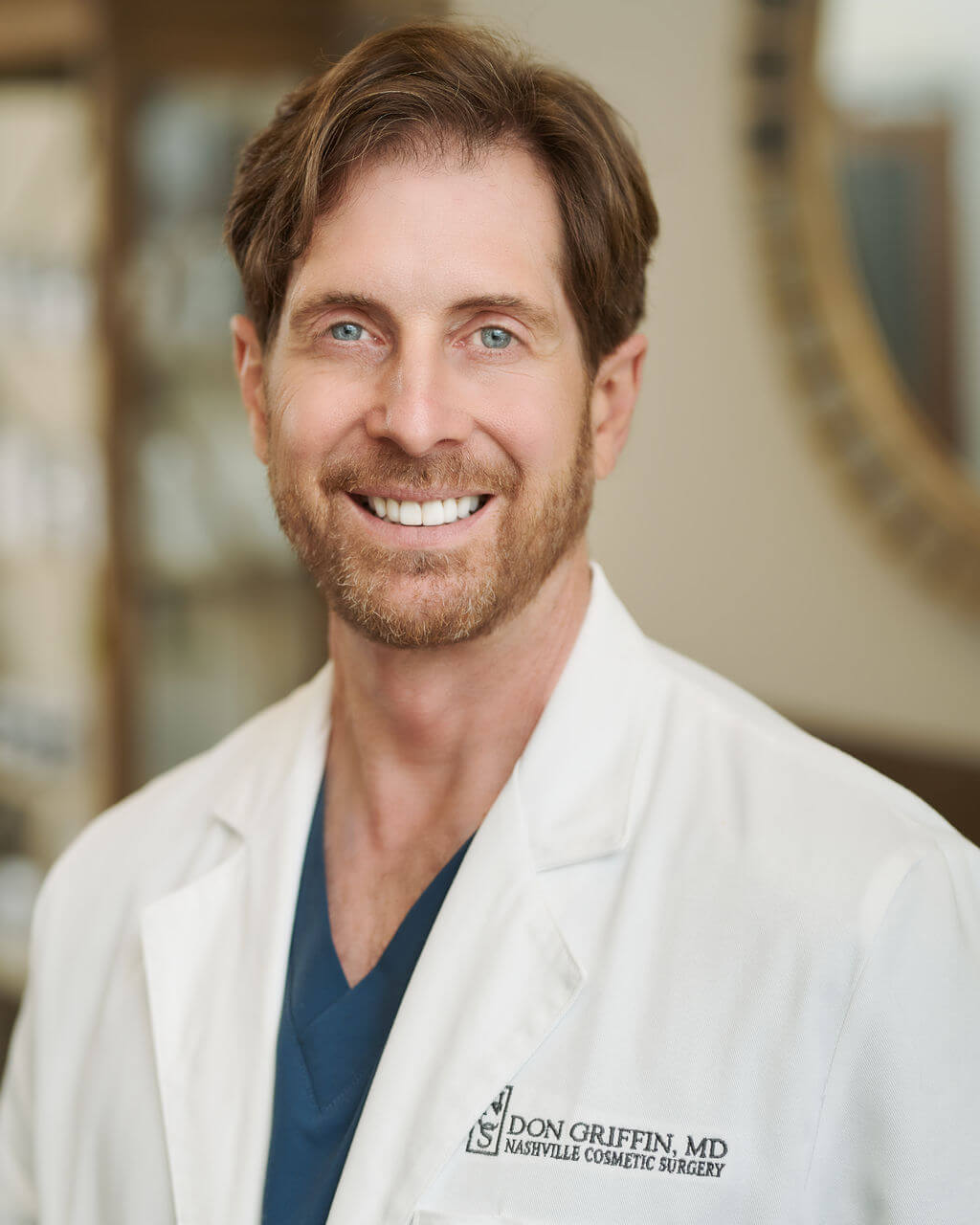
DON GRIFFIN M.D., FACS
Board-certified plastic surgeon Dr. Don Griffin realizes that no two patients are exactly alike — and neither are his surgical plans. Learn more about his background and his unique approach.
REQUEST A CONSULTATION
Dr. Griffin and The Skin Lounge at Nashville Cosmetic Surgery team want to help you look your best. Let’s start working together today. Request your consultation or call us at (615) 206-2937 to book your appointment.